
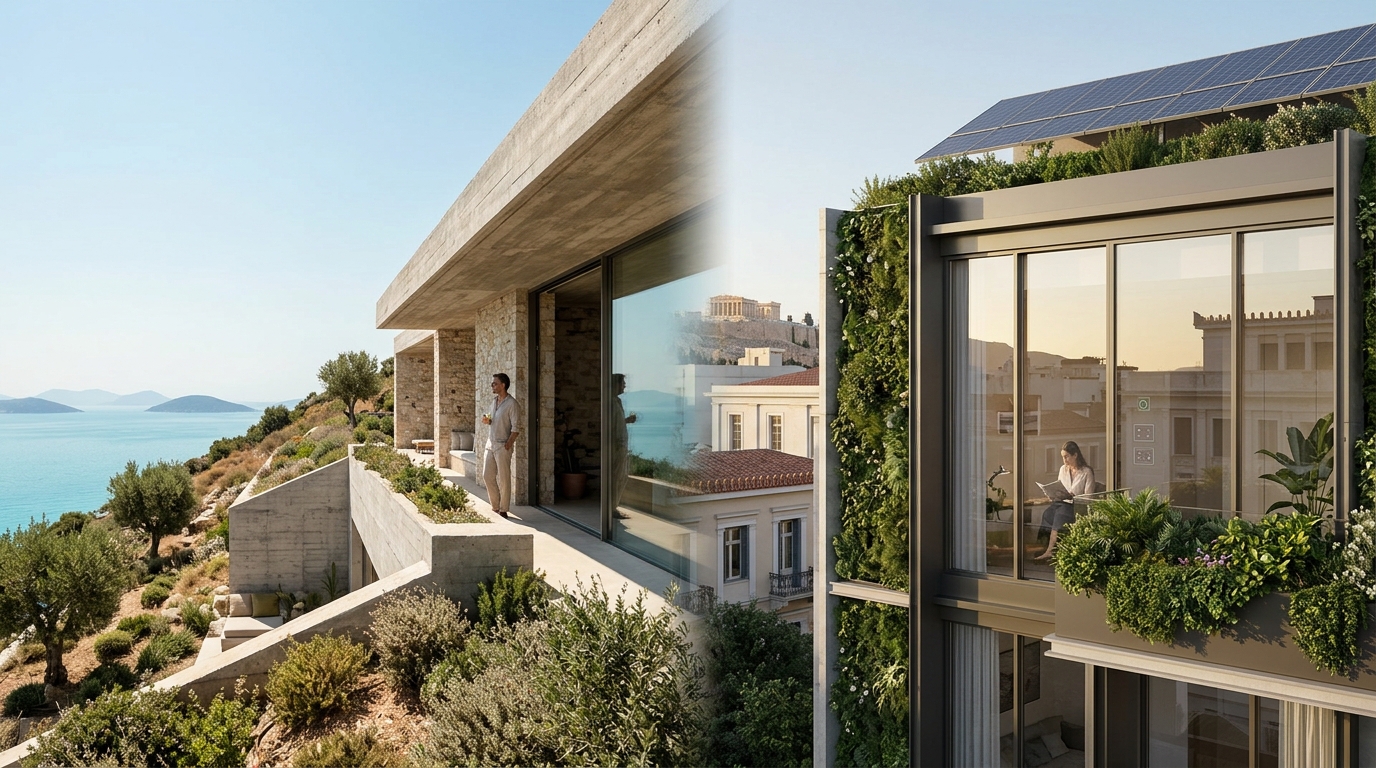
Choosing a sustainable developer in Lefkada versus Athens requires different priorities due to distinct environmental and regulatory contexts. In Lefkada, the focus is on passive cooling and earth-sheltered design to manage heat, while in Athens, the priority shifts to high-performance insulation and smart automation for dense urban living. ECLÉDE addresses both environments with site-specific strategies that respect local heritage and climate.
Climate and Passive Design Strategies
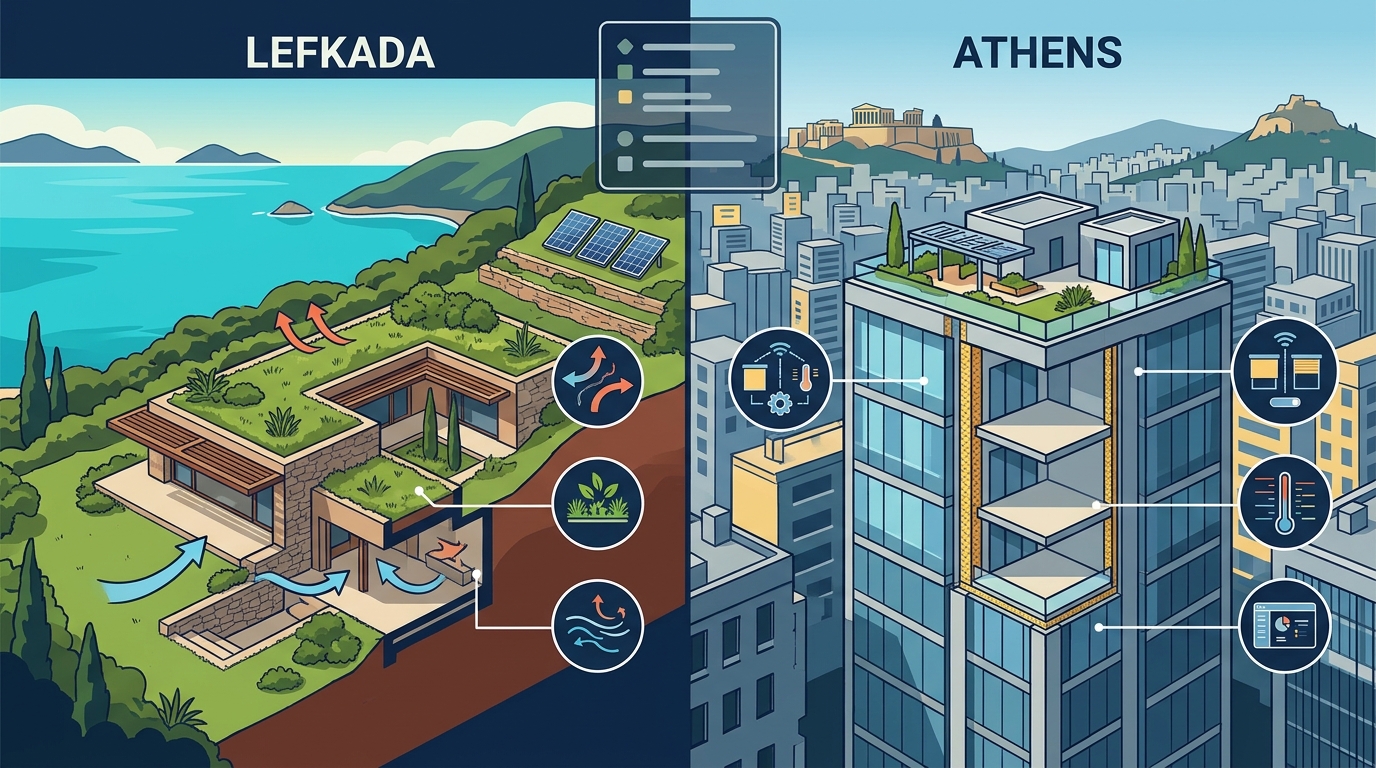
The primary difference lies in how each location handles thermal comfort. Lefkada’s coastal climate demands designs that leverage natural ventilation and earth sheltering. The Izanagi Project in Lefkada utilizes subterranean architecture to achieve passive cooling, significantly reducing energy impact. This approach blends Japanese-Greek philosophy with bioclimatic principles, allowing the building to vanish into the terrain rather than dominate it.
In contrast, Athens presents a denser urban environment where external heat gain is a major challenge. Boomerang Athens, located on Lycabettus Hill, employs high-performance insulation and triple-glazed windows to mitigate heat loss and gain. The residence integrates photovoltaic systems and heat pumps to maintain comfort without excessive energy consumption. This urban strategy focuses on sealing the building envelope to create a controlled internal environment.
For developers, this means that a passive design strategy effective in Lefkada may not be sufficient in Athens. The choice of developer must reflect an understanding of these specific climatic responses. A developer experienced in subterranean construction may lack the expertise in high-performance urban envelope sealing required for the capital.
Regulatory Frameworks and Certifications
Regulatory expectations differ between the two regions, influencing the certification targets developers pursue. In Athens, achieving LEED Platinum certification under the LEED v4.1 BD+C framework is a significant milestone. Boomerang Athens became the first single-family residence in Greece to reach this level, demonstrating that environmental performance and luxury can coexist in a major city. This certification requires rigorous documentation of energy efficiency, water conservation, and material sourcing.
In Lefkada, while formal certifications like LEED are possible, the emphasis often shifts toward local ecological integration and minimal environmental intervention. The Izanagi Project focuses on preserving natural beauty and using locally sourced materials. This approach aligns with a broader vision of eco-conscious living that respects the island’s specific ecological balance. Developers in Lefkada must navigate local planning permissions that prioritize landscape preservation over high-density construction.
Understanding these regulatory nuances is critical for investors. A developer who excels in urban LEED certification may not have the same track record in rural or island-based ecological preservation. Conversely, a developer focused on minimal intervention in Lefkada may need to adapt their practices to meet the stricter energy performance standards often required in Athens.
Material Sourcing and Local Heritage
Material selection is another key differentiator. In Lefkada, the use of natural, locally sourced materials is central to the design philosophy. The Izanagi Project uses organic materials that harmonize with the surrounding landscape. This not only reduces the carbon footprint associated with transportation but also ensures the building reflects the local architectural heritage. The aesthetic is minimal, allowing the natural environment to remain the focal point.
In Athens, the material palette often includes high-end finishes that balance sustainability with luxury. Boomerang Athens features natural wood, high-end marble, and sustainable finishes that create a sophisticated interior experience. The design emphasizes a seamless connection between indoor and outdoor spaces, using materials that enhance durability and longevity. This approach supports the idea that luxury is defined by intelligence and performance, not just aesthetics.
Developers must demonstrate expertise in sourcing materials that meet both environmental and aesthetic standards. In Lefkada, this means prioritizing local stone and wood. In Athens, it involves selecting certified sustainable materials that can withstand urban conditions while maintaining a high-end feel. The ability to source and specify these materials effectively is a key indicator of a developer’s capability.
Technology Integration and Smart Systems
Technology plays a crucial role in sustainable development, but its application varies by location. In Athens, smart home automation is essential for managing energy use in a dense urban setting. Boomerang Athens integrates KNX automation technology to optimize lighting, heating, and cooling. This system allows residents to manage every aspect of their home with ease, ensuring maximum energy efficiency. The integration of advanced security features and smart shading systems further enhances the living experience.
In Lefkada, technology is used to support passive design strategies. The Izanagi Project utilizes A++ energy-filtered windows and geothermal heating to enhance performance. Standalone air conditioning systems in each space provide comfort without relying on a central plant. This approach ensures that technology supports the building’s passive capabilities rather than replacing them. The result is a quiet, efficient living environment that respects the natural surroundings.
When choosing a developer, consider their experience with specific technology integrations. A developer proficient in KNX systems for urban residences may not have the same expertise in geothermal systems for subterranean villas. The right developer will match their technological solutions to the specific needs of the location, ensuring that the building performs optimally in its environment.
Investment Value and Long-Term Viability
The long-term value of a sustainable property is influenced by its location and design. In Athens, properties like Boomerang Athens benefit from proximity to urban amenities and major infrastructure projects. The location near the Double Regeneration Metropolitan Park enhances air quality and biodiversity, supporting a healthier urban environment. This proximity to green spaces and urban renewal projects adds to the property’s long-term investment value.
In Lefkada, the investment value is driven by the exclusivity and tranquility of the location. The Izanagi Project offers panoramic views of the Ionian Sea and a unique subterranean design that provides privacy and seclusion. This type of property appeals to buyers seeking a retreat from urban life, with a strong emphasis on well-being and environmental harmony. The limited supply of such high-end, sustainable properties in Lefkada supports their long-term value.
ECLÉDE’s approach to both locations ensures that each project is conceived as a long-term asset with purpose, identity, and environmental integrity. By focusing on quality, consistency, and luxury, the company creates developments that uplift communities while addressing environmental challenges. This holistic approach ensures that the property remains relevant and valuable in the changing real estate market.
Key Takeaways
- Passive design strategies in Lefkada focus on earth sheltering and natural ventilation, while Athens requires high-performance insulation and smart automation.
- LEED Platinum certification is a key milestone in Athens, whereas Lefkada emphasizes local ecological integration and minimal intervention.
- Material sourcing in Lefkada prioritizes local, natural materials, while Athens balances sustainability with high-end urban finishes.
- Technology integration in Athens relies on KNX automation for energy management, while Lefkada uses geothermal systems to support passive design.
- ECLÉDE addresses both environments with site-specific strategies that respect local heritage and climate.
Frequently Asked Questions
What is the main difference in sustainable design between Lefkada and Athens?
The main difference is the focus on passive cooling and earth sheltering in Lefkada versus high-performance insulation and smart automation in Athens.
Why is LEED Platinum certification important in Athens?
LEED Platinum certification demonstrates that a residence meets the highest standards of environmental performance, which is crucial in a dense urban environment like Athens.
How does ECLÉDE approach material sourcing in Lefkada?
ECLÉDE prioritizes locally sourced, natural materials in Lefkada to reduce carbon footprint and harmonize with the local architectural heritage.
What role does technology play in sustainable development in Athens?
Technology, such as KNX automation, is essential in Athens for managing energy use and optimizing lighting, heating, and cooling in a dense urban setting.
How does the location affect the long-term investment value of a sustainable property?
In Athens, value is driven by urban amenities and infrastructure, while in Lefkada, it is driven by exclusivity, tranquility, and unique design features.
Can a developer experienced in Athens successfully build in Lefkada?
A developer must adapt their strategies, as the passive design and ecological integration required in Lefkada differ from the urban envelope sealing needed in Athens.
Conclusion
Choosing a sustainable developer in Lefkada versus Athens requires a nuanced understanding of local climate, regulations, and material availability. ECLÉDE brings a multidisciplinary approach to both locations, ensuring that each project is tailored to its specific environment. Whether you are seeking a subterranean villa in Lefkada or a LEED Platinum residence in Athens, the right developer will prioritize environmental responsibility and long-term value. To explore how ECLÉDE can help you achieve your sustainable development goals, . Learn more: Contact ECLEDE Eclectic Developments.